

Características
The University Pathway Program is for international students who plan to earn a degree in Argentina and need to improve their Spanish first. Argentina is an excellent place to study at a university and we help you prepare for this objective.
You study intensive Spanish at Academia Buenos Aires, and we guide you through choosing a university and degree, meeting the admission requirements, getting a transitory visa for your pathway program, helping you prepare the necessary documents and getting ready for university life. From the first week, your Spanish studies work toward a specific academic goal.
Spanish with a purpose
Your Spanish course is the core of the program: 20 hours per week in groups of no more than eight students. You can start at any level.
As your Spanish improves, classes focus more on what you will need at university: reading academic texts, writing, giving presentations, taking part in discussions and preparing for exams.
How much preparation you need depends on your starting level and on your university. A beginner needs a different plan from a student who already speaks intermediate or advanced Spanish.
Preparing for your university
We help you compare universities and degrees in Argentina and find the ones that fit your plans. Once you have chosen, we go through the admission and registration procedure of that specific university and faculty with you, because requirements differ from one institution to the next.
We also explain which academic documents you need, such as your secondary-school diploma and transcripts, and when they must be apostilled, legalized or officially translated.
We help you prepare. The admission decision is always made by the university.
SIELE and Spanish certification
Many universities ask international applicants to prove their level of Spanish. If your chosen university accepts SIELE, we help you find out which level you need and prepare you for the exam. Academia Buenos Aires is an official SIELE exam center, so you can also take the exam with us.
The University of Buenos Aires, for example, requires C1 Spanish from applicants whose secondary-school diploma comes from a non-Spanish-speaking country, with SIELE among the accepted certificates. Other universities often ask for a lower level, so check the requirement of your university and degree before you decide which exam to take.
Getting ready for university life
At university you will read, write, listen and speak in an academic setting, and you will deal with professors, classmates and administration offices in Spanish. Depending on your level, we work on academic vocabulary, written assignments, presentations, seminar participation, note-taking and exam skills.
We also advise you on practical matters such as accommodation and the general immigration and residency procedures. Immigration requirements depend on your nationality and personal situation, so always confirm them with the Argentine authorities or ask us for advice.
How long does the pathway take?
Getting a transitory visa can take you between 1 week and 3 months, depending on your nationality. The length of the pathway itself depends on three things: your current Spanish level, your university's language requirement and your intended start date.
Most Spanish beginners need around 10 months to reach an acceptable level of Spanish, depending on the university. If you start in January or February, you prepare during that year, register with the university at year-end and begin university in March of the following year. Students with intermediate or advanced Spanish need less time and can move on sooner to academic Spanish, certification and university preparation.
We recommend planning backward from the date you want to start university. At the beginning of the program, we draw up a realistic timeline with you.
Example timelines: starting university in March 2028
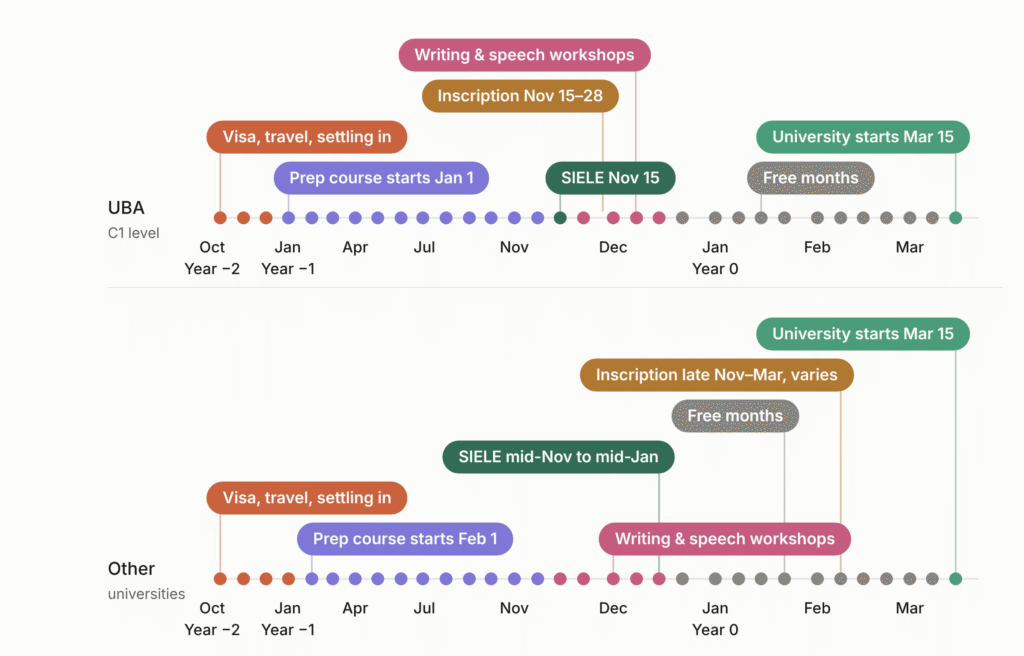
Year −2 = 2026, Year −1 = 2027, Year 0 = 2028. Registration dates change every year and differ between universities. Dates given are indicative and cannot be generalized.
- October to December 2026: enrollment, student visa, travel and settling in.
- First week of January 2027 (UBA) or February 2027 (other universities): your Spanish course begins.
- November 2027: SIELE exam. For UBA, take it around November 15: UBA registration runs in the second half of November, and the C1 certificate is due in the first week of December. For other universities, the exam can be taken between mid-November and mid-January or even later.
- After the SIELE exam: writing and speech workshops to prepare you for academic work, if time allows. They are included in the fee.
- Late November 2027 to March 2028: university registration. At UBA this is the second half of November; at other universities the dates vary.
- Until classes begin: free time to travel, find long-term accommodation and settle in. If and when needed, we help you extend your transitory visa.
- March 2028: your university studies begin. Dates vary by university and year.
Mid-year intake as a fallback
UBA also admits students for the second semester. In 2026, registration for the mid-year intake ran from June 26 to July 13. If you need more time to reach the required level, you can aim for a mid-year start and extend your Spanish course at a proportional rate. We can tell you if your chosen university offers a mid-year intake.
University Pathway fee
This fee applies to students who start as beginners. It is paid once, at the beginning, and includes as our services to you:
- providing required invitation documents for transitory student visa required to study Spanish in Argentina
- 10 full months of intensive Spanish classes
- guidance on choosing a university and degree (max. 2 private online sessions)
- help determining university-specific requirements, registration and admission
- general immigration orientation
- help in document preparation (e.g. translations, legalizations in Argentina)
- SIELE planning and inscription
- writing and speech workshops after the SIELE exam, if time allows
The fee does not include the cost of the SIELE exam (currently 155 Euros), translations, university application fees (where they apply), etc.
If you need an additional month or more of classes to reach C1, you can book it separately. If you start at a higher level and need a shorter pathway, or need more time, we adjust the price of your program according to its length.
The program suits international students who are seriously considering a degree in Argentina and want to prepare for it in Buenos Aires.
Contact us to discuss your plans, assess your starting level and find out what your University Pathway could look like.
Read more: Study at a University in Argentina · How to study at a university in Argentina
- Level assessment (oral and written) before starting
- Study materials (textbooks and other resources)
- Access to the online platform up to level intermediate B1 if requested
- Optional exams at the end of each level and at the end of your stay
- Certificate stating the number of hours completed and level attained (including grade if the exam is passed)
- Two to three extracurricular activities per week (guided tours, museum visits, tango, workshops, excursions, etc.)
- Wi-Fi access
- Hot and cold beverages
- Access to the library
- Movie screenings and discussions (usually once a week)
- Assistance with organizing trips around Uruguay and Latin America
- 24-hour hotline available in Spanish, English, French, and German
Student Stories


Frequently Asked Questions
Yes. Buenos Aires is one of the best places in the world to study Spanish, combining full language immersion with a rich cultural life, welcoming people, and a variety of Spanish that is widely understood across Latin America and beyond. Buenos Aires offers constant real-life practice. Locals are known for being open, expressive, and eager to talk—whether in cafés, neighborhoods, or social settings. The city’s cultural scene is vibrant and accessible: music, literature, film, food, and everyday street life all become part of your learning experience. From a linguistic perspective, Argentine Spanish—especially Rioplatense Spanish—functions much like the difference between British and American English: distinctive, but fully transferable. Students who learn Spanish in Buenos Aires can comfortably communicate throughout the Spanish-speaking world.
The Spanish spoken in Buenos Aires is known as Rioplatense Spanish, a regional variety used in Argentina and Uruguay, particularly around the Río de la Plata area. Rioplatense Spanish is characterized by a distinct pronunciation, including the use of vos instead of tú (voseo), and a noticeable pronunciation of the letters “ll” and “y,” which are often pronounced with a soft “sh” or “zh” sound. Its intonation reflects historical European immigration, giving the accent a recognizable rhythm. Despite these features, its grammar and core vocabulary follow standard Spanish norms and are widely understood. For learners, this means studying Spanish in Buenos Aires offers exposure to a clearly identifiable regional accent while providing a solid and transferable foundation for communication across the Spanish-speaking world.
When choosing a Spanish school, pay close attention to class size, teaching quality, accreditation, and how personalized the learning experience is. These factors directly affect how much you speak, how fast you progress, and how supported you feel. Class size matters more than many people realize. A class with 8 students allows significantly more speaking time and individual feedback than one with 16, even if both are called “small groups.” Teacher quality and stability are also important: larger, well-established schools are often better able to attract and retain experienced teachers. Accreditation is another key indicator. Schools recognized by the Instituto Cervantes meet defined academic and organizational quality standards. Finally, flexibility matters: fast answers from real admin staff, the ability to change class levels without extra cost, and included cultural or extracurricular activities all contribute to a better learning experience.
Yes. Adults of all ages can successfully learn a new language. Experience consistently shows that motivation, consistency, and learning habits matter far more than age. Many students who come to Buenos Aires are highly motivated, with a genuine interest in the language, culture, and people. At our school, we welcome students of all ages—from teenagers to retired learners—and progress varies widely from person to person. Factors such as recent study experience, prior exposure to foreign languages, and awareness of how one’s own language works often matter more than age itself. While some older students may take a bit longer with certain aspects, others progress extremely fast. We’ve seen students in their 60s and 70s “outperform” much younger classmates thanks to focus, discipline, and motivation.
No. Classes are taught primarily in Spanish from day one. English is used only as a last resort, when absolutely necessary to clarify a specific point. Teachers are trained to make Spanish understandable through repetition, gestures, visual cues, simple structures, and gradual progression. This immersive approach helps students start thinking in Spanish instead of translating. Our experience supports this method. With more than 20,000 former students, learning in Spanish from the beginning has proven to build confidence faster and lead to stronger communication skills.
Yes. Many students travel to Argentina without speaking Spanish, and Buenos Aires is one of the easiest cities in Latin America to navigate in that situation. Argentina consistently ranks at the top of the region for English proficiency, especially in Buenos Aires, where English is commonly spoken in airports, hotels, cafés, and tourist services. A large number of our students arrive with little or no Spanish. We can arrange airport pickup, and host families are experienced in welcoming students who don’t yet speak the language. At the school, teachers and staff regularly work with absolute beginners and guide them step by step. Most students learn basic Spanish very quickly, and locals are generally friendly, patient, and willing to help—making daily life manageable from the start.
How fast you learn Spanish depends on your background, motivation, and how much you practice outside the classroom. Previous experience with foreign languages—especially Romance languages—can speed up progress, as can daily interaction with Spanish speakers through host families or social life. For beginners starting from zero, typical progress aligned with the Common European Framework of Reference for Languages (CEFR) looks like this: After 2–3 weeks: You can introduce yourself, ask basic questions, and handle simple daily interactions. After 2–3 months (around 200 hours): You can get around confidently, understand everyday Spanish, and communicate comfortably in common situations. After 5–6 months: Many students approach an independent level (around B1–B2), allowing them to function socially and even follow lectures related to their field of knowledge. Individual progress varies, but immersion in Buenos Aires often accelerates learning significantly.
Buenos Aires is generally more affordable than most cities in Europe and North America, although costs can vary depending on the economic situation. Some expenses, such as supermarket food, can be comparable to prices abroad. However, rent is usually lower, and everyday costs like public transportation and taxis are much cheaper. Going out, cultural activities, and social life are also more accessible, even if not inexpensive by local standards. For many foreign students, this balance makes Buenos Aires an attractive destination: a major international city where it’s possible to study Spanish and enjoy an active cultural life without the high costs of many other global capitals.